
Most places that sell returns give you one word for the whole thing. Good. Fair. Open box. One word is a summary, and a summary hides the thing you actually wanted to know: is the scratch on the front or the back, does the remote come with it, has anyone turned it on. Bidvana publishes four scores instead, each in the inspector’s own words, with a photo behind every low one. This guide is how to read them in about a minute.
Four scores, no overall score
An inspected unit is scored on four separate facets: cosmetic, function, completeness and packaging. Those four scores are the condition. There is no score above them, no letter, no single star rating that averages a cracked lid against a spotless bowl. The report on the product page shows every one of them, with the inspector’s note and the photo behind it, and the chips on the card carry the same four scores at a glance.
Each facet is scored from 1 to 5, but the inspector never picks a number. They pick a word from a fixed list of five, and the word is what you see. Here is what the lists are.
The four facets, one by one
- Cosmetic. How it looks and smells: marks, scuffs, dents, cracks, stains, odor. The words, top to bottom: No marks, Faint marks, Visible wear or light staining, Heavy wear stain or odor, Damaged cracked or permanent odor. A 4 is the kind of mark you find when you go looking; a 3 is the kind you notice from across the room.
- Function. Whether it works, when a technician powered it on. Fully works, Works minor quirk, Partial function, Major fault, Dead. A quirk is a sticky button or a slow start; partial function means something it is supposed to do, it does not do.
- Completeness. Whether everything that belongs in the box is there. Everything present, Missing a trivial item, Missing a minor item, Missing a major item, Missing a core part. A trivial item is a twist tie or a manual; a core part is the thing without which the product does not do its job, like a blender’s jar.
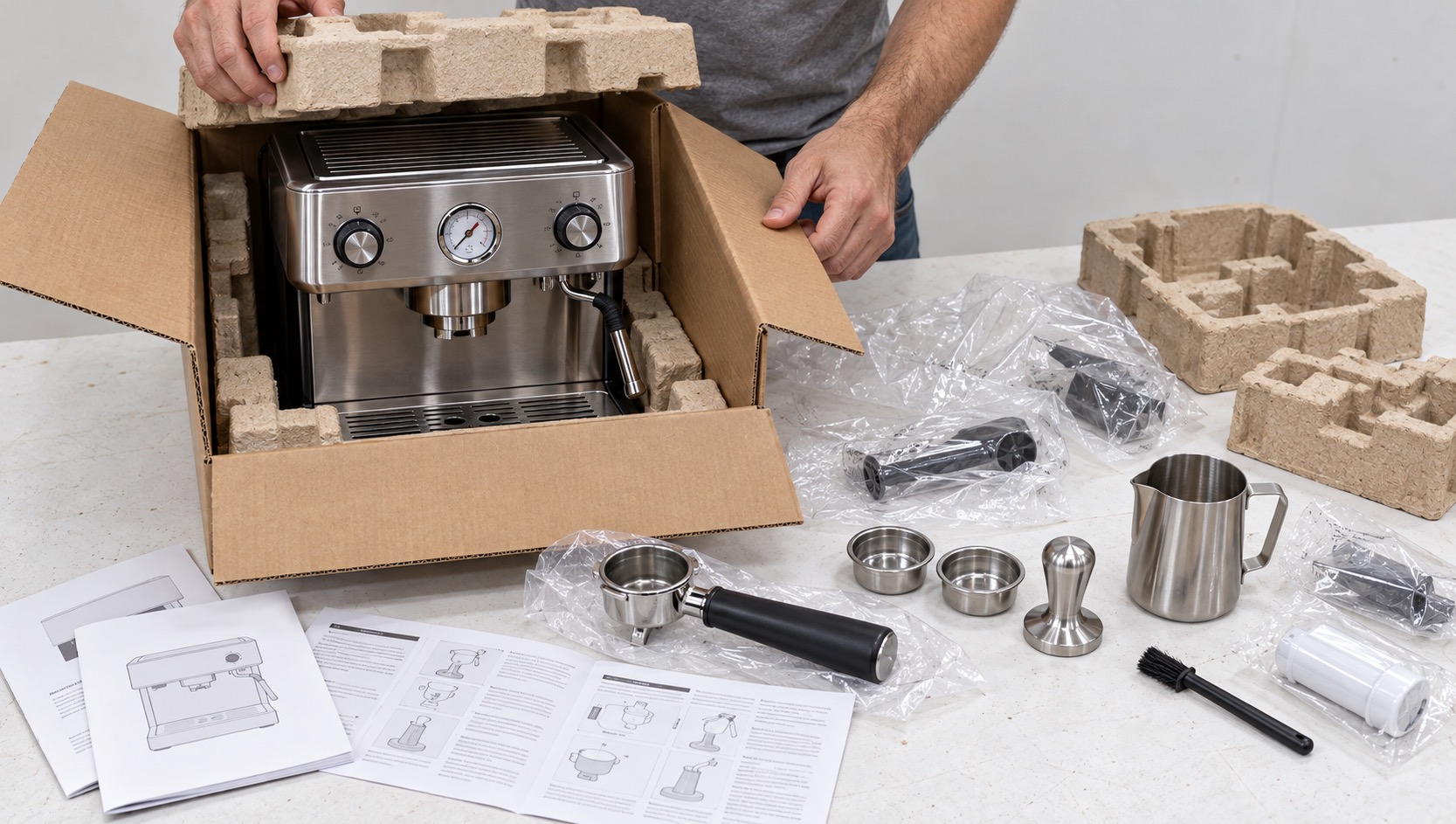
- Packaging. The box and how the contents sit in it. Original box factory packed, Original box repacked well, Original box loose inside, Plain box packed well, Loose in a plain box. This one matters for gifts and for resale, and hardly at all for a vacuum you are going to use tonight.
A facet nobody could judge is left unscored rather than guessed at. Nothing is assumed in our favour: a unit nobody powered on reads Not tested on Function, never as working, and an item with nothing to switch on, like a vase, reads N/A there instead.
What the chips on the card mean
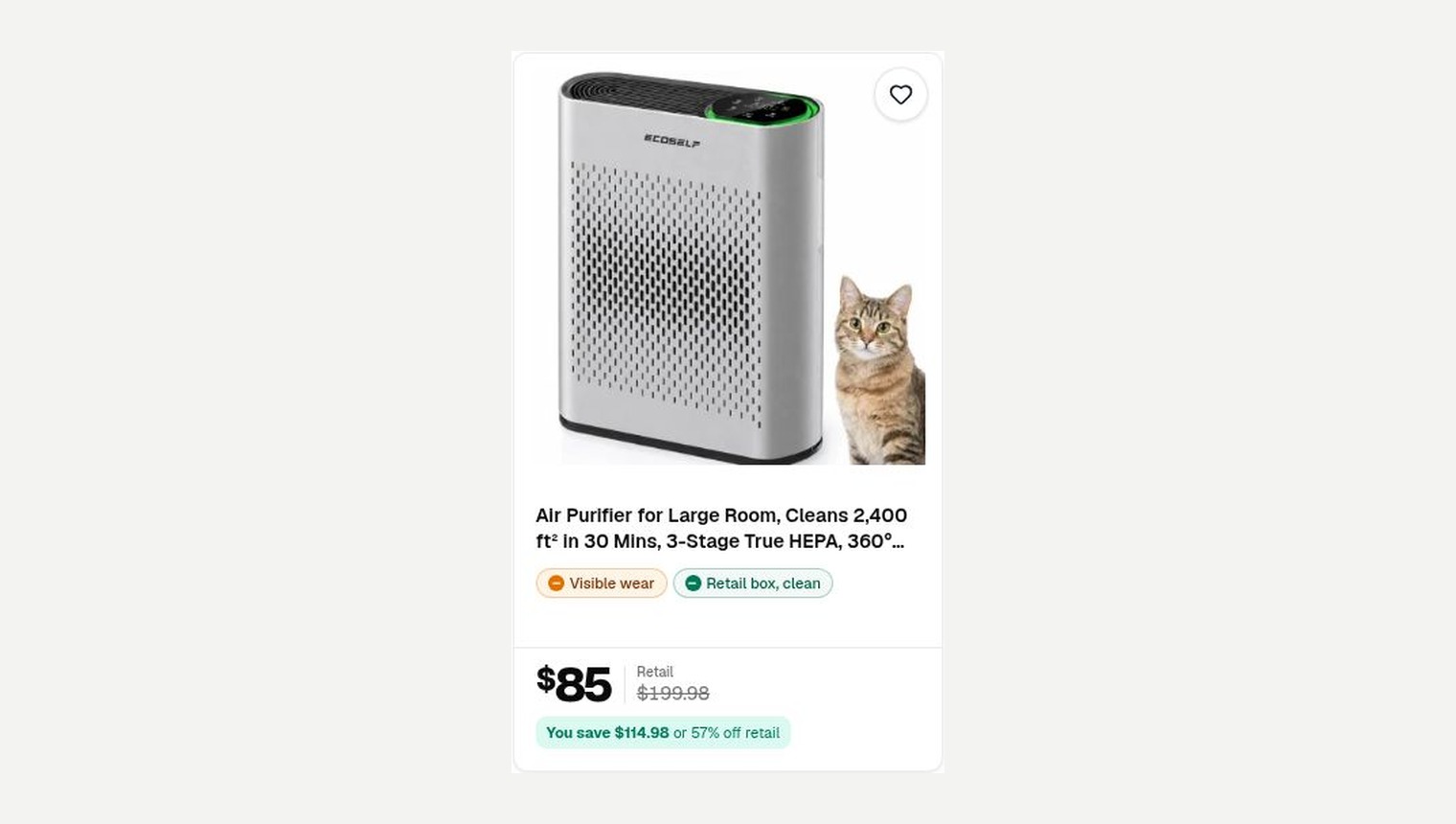
You do not have to open the report to get the headline. Every product card carries a row of four chips, one per facet, each with its short name and its score: Cos, Fnc, Com, Pkg. The colours are a quick read:
- Green is a 5 or a 4: either nothing to flag, or a small imperfection worth knowing about and not worth worrying about.
- Amber is a 3: look at the photo before you decide. Visible wear, Partial function, Missing a minor item.
- Red is a 1 or a 2: a real fault or a real gap, and usually a much lower price to match. Heavy wear, Major fault, Missing a core part.
- A dash means that facet has no score yet. On Function it reads Not tested, or N/A when there is nothing to switch on.
Open the report and you get the same four facets in full: the word behind each score, the inspector’s reason, and the photo that goes with it. A card marked Not inspected is different again: a person has not scored it yet, which is not a claim that nothing was wrong.
What Like new means
The Like new badge is the closest thing to new in the shop, and it is a rule, not a feeling. A unit earns it when all four facets scored a 5 at once: No marks on cosmetic, Fully works on function, Everything present on completeness and Original box factory packed on packaging. Every facet has to be scored; a unit nobody checked cannot qualify by default. The shop’s Like new filter uses exactly the same test as the badge.
Why a low score always has a photo
Any facet scored 3 or lower has to carry a photo of that exact thing, taken while the unit was in the inspector’s hands. Not a stock image, not a photo of a similar unit: the scuff, the missing part, the stained corner, on this one. The product page publishes it beside the row it belongs to, so a claim about wear is something you can look at rather than take our word for.
The notes work the same way. They are written by the person who held the unit, in their own words, and they tend to say the useful thing: which corner, which accessory, whether the cord was in the box. Read them. They are the closest you can get to turning the thing over yourself.
The three scores that name a real fault
Three scores name a serious fault: cosmetic Damaged cracked or permanent odor, function Major fault or Dead, or completeness Missing a core part. A unit with any of them is priced for exactly what it is, and the fault is named on the listing, so there is never a mystery about why it is cheap. Every unit is sold as-is and final sale, this one included, and buying it is accepting the fault we named. What the three-day window still covers is us having described that fault wrongly or incompletely.
Not inspected, and Coming soon
Not every unit has been through inspection. A card marked Not inspected was listed straight from the receiving dock with the retailer’s condition assessment and our photos, and no facet scores yet. It is an honest starting point that we stand behind the same way, with the same 3-day guarantee.
A card marked Coming soon is a unit in our warehouse waiting its turn. It shows its price and details, but you cannot buy it until a technician has scored it. Press Request Inspection and it moves up the queue; it can take up to 24 hours. The price will not go up after inspection. It may come down if the unit is in worse shape than the manifest claimed, and in that case the lower price is the one you pay. The Coming soon explainer covers the rest.
How the scores set the price
The price is not a guess either. It starts from the item’s current retail price, takes the discount for its category, and then moves by a set amount for every facet that scored below perfect. The facets that change what you get move it most: a missing accessory or a functional quirk costs more than a worn box. Two units of the same product with different chips will have different prices, and you can see exactly which chips made the difference.
The guarantee
The report is a promise. If we scored a unit wrong or missed something, tell us within 3 days of delivery and we arrange a return for a full refund. That covers anything not as described, in the scores, the photos or the notes, including a fault we understated. It is the only return we offer: everything is otherwise sold as-is and final sale, so a unit that matches its report stays yours.
Reading a report in sixty seconds
Read the chips
Green, amber, red, or a dash. Four chips is the whole condition in one glance.
Open the report
On the product page, four rows with their words and bars. The lowest one is the one to think about.
Look at the photo behind any amber or red row
It is the actual mark or the actual gap on this unit. Decide whether you can live with it.
Read the inspector’s note
Which corner, which accessory, whether it was in the box. The note usually answers the question you were about to ask.
Check the three serious scores
If it is there, the reason is named. If it is not, the 3-day guarantee applies.
Compare the price to the chips
A unit with one green chip and a big discount is the sweet spot. A unit with an amber chip is worth the extra minute on the photo before you decide.
That is the whole system. If you want the formal version, with every anchor word in a table, the rules for unscored facets and the exact Like new test, the scoring rules are the reference the product pages follow.